Resource
👩🏫 Ace Your Next Marketing Ops Interview (What MOPs Hiring Managers Are Actually Looking For)
9/22/2025
Why Marketing Ops Hiring Is DifferentWho’s Interviewing You And What They’re Looking ForWhat Strong Candidates Consistently ShowCommon Interview Questions & Great Answers (Table)How to Stand Out in the Interview ProcessGetting Ghosted? What To DoWhat About When Things Go Wrong?What About Projects or Assignments?Want to Practice or Share?
Why Marketing Ops Hiring Is Different
Marketing Ops roles aren’t just technical — they sit at the crossroads of:
- 📈 Data, tooling, and campaign execution
- 🤝 Cross-functional collaboration with RevOps, Demand Gen, Sales, and Product
- 🧠 Strategic thinking and business impact
- 🗣 Clear communication with technical and non-technical stakeholders
Great MOPs hires balance hands-on execution with the ability to drive measurable business outcomes.
Don’t focus too much on technical expertise, and not enough on the other areas.
Who’s Interviewing You And What They’re Looking For
In Marketing Ops interviews, your panel might include a mix of stakeholders, each with a different lens on what "great" looks like. Knowing what type of persona you're speaking to helps you tailor your responses.
Persona | What They Care About | What Angle They’ll Take |
VP of Marketing / Demand Gen | Pipeline creation, campaign velocity, ROI | “How have you helped drive measurable results from marketing campaigns?” |
Marketing Ops Team Lead / MOPs Manager | Technical execution, process efficiency, scalability, strategy | “How do you QA campaigns before launch?” or “What’s your process for lead lifecycle management?” |
RevOps or Sales Ops Leader | Funnel alignment, attribution, lead quality | “How have you collaborated with Sales to improve lead routing or reduce lead aging?” |
Sales or SDR Manager | Speed to lead, lead quality, follow-up workflows | “What’s your process for ensuring leads are qualified and routed correctly?” |
Data Analyst / Marketing Analytics | Clean data, tracking consistency, reporting reliability | “How do you handle inconsistent UTMs or campaign tracking errors?” |
Product Marketing or Content Lead | Messaging alignment, campaign timing, audience segmentation | “How do you make sure campaigns hit the right audience with the right message at the right time?” |
Ask who will be in the interview and look them up ahead of time. Tailor your language: use business terms for execs, tactical terms for fellow MOPs pros, and collaborative language for cross-functional peers.
Even better: be very friendly with the recruiter and ask them for intel — where previous candidates have stumbled, the most important experience that specific person cares about for this role, etc — you’ll be pleasantly surprised how much they can help prepare you, if you befriend them.
What Strong Candidates Consistently Show
🫶 Connect Campaign Work to Revenue Impact
- Go beyond “I ran the emails” and speak to how you moved the needle — conversion, influenced pipeline, velocity, etc.
🫶 Systems Thinking
- Understand dependencies across the funnel — lead scoring, routing, attribution, campaign ops, and reporting. Show you think critically and are not just an order taker.
🫶 Ruthless Prioritization
- Show how you triage requests and focus on what drives impact.
🫶 Stakeholder Fluency
- Translate MAP (marketing automation platform) logic into business language for VPs and cross-functional teams.
🫶 Strong People + Communication Skills
- Show how you can get along well with others, build trust, push back kindly but firmly, handle mistakes, and be a pleasure to work with.
🫶 Curiosity Over Compliance
- Audit, optimize, and proactively solve problems instead of just following orders.
🫶 Hunger to Learn
- Managers want a candidate who wants to learn and grow, especially if you’re applying for a more junior role.
Common Interview Questions & Great Answers (Table)
Most Marketing Ops interviews follow similar patterns, but standout candidates separate themselves with how they answer. Below is a breakdown of frequently asked questions, common weak responses, and what a strong, impact-focused answer looks like using the STAR method (Situation, Task, Action, Result) where applicable.
If you can, practice these questions with a peer, family member, friend — even better if you can record yourself answering. This way, you can get feedback from another human as well as your own self reflection of how you meant to come across vs. how you actually came across. There are online services for this too! Just Google “mock interviews.”
Use this as a prep guide — or a self-audit checklist — to sharpen your own storytelling.
Interview Question | Weak Answer | Strong Answer |
Tell me about a marketing process you improved. (STAR) | “I created a Marketo nurture for inbound leads.” | “Inbound MQL-to-SQL rate was 3% (S). I audited the nurture, added progressive profiling, and updated scoring (T/A). Result: 18% lift in qualified leads in 6 weeks (R).” |
How do you manage competing requests from different teams? | “I just do them in the order they come in.” | “I implemented a request intake with effort/impact scoring and weekly prioritization meetings. Result: reduced ad hoc asks by 40%.” |
Describe a time a campaign didn’t go as planned. (STAR) | “There were some send errors, not my fault.” | “A UTM error caused misattribution (S). I corrected the data and added automated link QA (T/A). Prevented 3 similar issues later that quarter (R).” |
How do you measure your impact? | “We track campaign volume.” | “I report on MQL-to-SQL, pipeline influence, and conversion velocity. A recent process update improved SAL rate by 15%.” |
Tell me about a time you improved data quality. (STAR) | “I cleaned duplicates.” | “Webinar imports caused bad data (S). I added validation rules and standardized formats (T/A). Result: 70% drop in support tickets (R).” |
How do you collaborate with Sales/RevOps? | “We message each other on Slack.” | “We co-created lead lifecycle stages, shared dashboards, and SLAs. Lead aging dropped 30%, SDR follow-up improved.” |
Give an example of stakeholder misalignment. (STAR) | “We disagreed on scoring.” | “Demand Gen wanted all webinar leads MQL’d (S). I showed low conversion data, tested new model (T/A). Result: 2x SAL rate for that channel (R).” |
Walk me through a project you led. | “I set up routing in SFDC.” | “I mapped gaps, collaborated cross-functionally, rebuilt logic (T/A). Result: 85% drop in misrouted leads, SDR follow-up time improved by 2 hours.” |
What’s your biggest weakness? | “I’m a perfectionist.” | “I used to over-polish campaign assets before sending them to the team. I’ve since built a ‘good enough’ checklist and added early review checkpoints to stay agile.” |
How do you handle feedback or criticism? | “I usually just go with the flow/I take it personally.” | “When a campaign underperformed, my manager pointed out that the segmentation logic was too broad. I took the feedback, reviewed the data, adjusted filters, and shared post-campaign insights with the team. The next send saw a 30% lift in engagement.” |
What motivates you in a MOPs role? | “I like working in tech.” | “I love building scalable systems that help marketers move faster and smarter. Seeing a campaign go from idea to measurable pipeline impact is incredibly rewarding.” |
How do you stay up to date in Marketing Ops? | “I follow a few blogs.” | “I regularly attend MO Pros events, subscribe to newsletters like The Marketing Ops Strategist, and experiment in sandbox environments when new platform features roll out.” |
Tell me about a time you had to learn something new quickly. (STAR) | “I watched a YouTube video.” | “We needed a last-minute integration with a webinar platform (S). I reviewed vendor docs and tested configurations in Marketo (T/A). It launched on time and synced 2,000+ attendees cleanly (R).” |
Tell me about a challenging professional relationship and how you handled it. (STAR) | “One of the PMs was difficult, so I just avoided them.” | “A Demand Gen manager frequently bypassed our intake process and submitted last-minute campaign requests (S). I set up a 1:1 to understand their pressure and suggested a light intake form they could submit in under 2 minutes (T/A). Over time, we built trust, and requests became more structured and collaborative (R).” |
Tell me about (a recent MOPs book you read, where you get your latest MOPs info, your favorite TV show right now). | “I forgot.” | “I recently read The Revenue Operations Manual by Sean Lane & Laura Adint. It solidified frameworks I already used (operating rhythms, forecasting) and pushed me to think more critically about how Marketing Ops intersects with broader RevOps work. For example, one chapter inspired me to revamp our reporting to better track outcomes — not just outputs — so I could have stronger conversations with Sales and Execs.”
(Note from Sara: I don’t love these types of “gotcha” questions, but it doesn’t hurt to have a list nearby of books you’ve recently read, movies you’ve recently seen, tv shows, etc — for easy reference, if you tend to draw a blank when put on the spot.) |
A question about your specific field or job you’re applying to.
Think: SFMC Admin | Not being prepared. | If in doubt, plug the job description in ChatGPT or the equivalent and ask it to come up with typical interviewer questions about the technical or more specific parts of that specific role. This can help you feel more prepared! |
The hardest part of nailing interviews is having the stats to brag about — keep an ongoing brag book slide deck or at least a Google Doc that has measurements of the impact you’ve had at each job, so you don’t have to scramble to try to find or come up with these right before the interview process.
How to Stand Out in the Interview Process
✨ Bring a portfolio or slide deck
- Screenshots or walkthroughs of dashboards, campaign architectures, data flows, or QA processes are helpful and can make your pitch easier to follow.
One of the top complaints I hear from hiring managers is “they weren’t specific enough.” Make sure you’re answering questions directly and clearly, with supporting evidence…STAR helps with this! It also helps to have a portfolio or slide deck to point to, as you speak.
📁 Showcase templates or SOPs (Standard Operations Procedures) you've created
- Documented workflows, intake forms, scoring models, routing diagrams also help build credibility and guide the conversation (if applicable to role).
🧠 Show your thinking
- Be ready to talk through tradeoffs, process decisions, roadblocks, and how you measured success.
🗣️ Be an active participant, make it conversational
- Don’t answer questions and then just sit. Come prepared with a list of questions you have for the interviewer, and then think of questions live, in the context of the interview. The best interviews feel like conversations with a back-and-forth, not a one-sided interrogation or Q&A.
📒 Keep a Brag Book
- Maintain an ongoing doc with:
- Campaign wins with measurable impact
- Before/after screenshots of systems or processes
- Shoutouts from stakeholders or Slack praise
- Metrics you've improved or owned
This makes prepping for interviews (and promotions) way easier—and more impactful.
🪞 Look polished
- Listen, I hate getting dressed up, and I hate having to be super proper…but do make sure you look appropriate for the interview. This could mean something as simple as a clean black sweater — it looks nice, but it isn’t trying to hard. Most tech companies are happy with “smart casual” outfits for interviews, whereas finance and more formal companies may want a “professional” look with collared shirts, blouses, or dresses. When in doubt, ask the recruiter what they recommend.
- If you’re going on a Zoom interview, check out your background and make sure it isn’t distracting. No random items where your interviewer might be wondering “What IS that?” or anything that is too attention-grabbing. You want the person listening to you, not wondering what’s going on in your apartment or house. If you must have something distracting in your background (installed painting, furniture, etc), you could look into using “blur your background” functionality to at least make these items less distracting.
✍️ Do your research
- Look up the company and person you’re interviewing with beforehand, pull together a doc that you can study and reference. You don’t want to come across as a stalker, but you do want to at least come across like you care.
- One of my favorite little tricks is to use builtwith.com to look up the domain of the company and check out their martech stack. If I see that they have pixels for both Marketo and HubSpot on their site, I’ll bring that up and ask if they are in the midst of migrating. People love these kinds of observations, it shows you know what you’re talking about and really care about this role.
- Also, know what kind of compensation you want…many places will tell you to avoid answering this question early on, and that is typically good advice — UNLESS you are serious about your comp and have a serious bottom floor (where anything less just wouldn’t work). Figure out your market rate by looking at sites and surveys, then figure out your bottom floor. When compensation comes up, in many states you can counter with “what is the pay range for this role?” and see what they say. In my experience, most companies will quote the lower end of their range and see if you balk — so if you’re in a position where you feel confident and are in multiple interview funnels, it might make sense to pitch a higher number back and see if they balk back at you. It all depends upon your position though, if you really just need a job and they can get close to the rate you want, it might not be worth the fuss to try to get $10k more with $xxx,xxx of compensation already in play. If you do have a true bottom-floor number, and you have a lot of opportunities, it might be worth being super upfront and getting to compensation earlier in the conversation, to conserve your energy for opportunities you can actually take.
📑 Have your own set of questions
- Have 5-10 questions written out and near you, so you can easily reference them. There will be an opportunity to ask these questions, and remember — you are interviewing the hiring manager, hiring committee, and company just as much as they are interviewing you. If they give non-answers, dodgy, or questionable answers to your questions, it’s worth digging in further to make sure that you aren’t noticing a huge red flag.
Getting Ghosted? What To Do
Even if you aren’t getting ghosted, it’s a great idea to network in to a job interview.
What do I mean by that? I mean, figure out who you know at that company and see if they are willing to give a warm intro to the hiring manager or recruiter. Aim for the hiring manager, settle for the recruiter.
You’re probably wondering — ok Sara, but how do I figure out who knows who?
Simple…LinkedIn. 🙂
Search for your target company on LinkedIn. Go to their LinkedIn company page, and see which connections you have that work at the company.
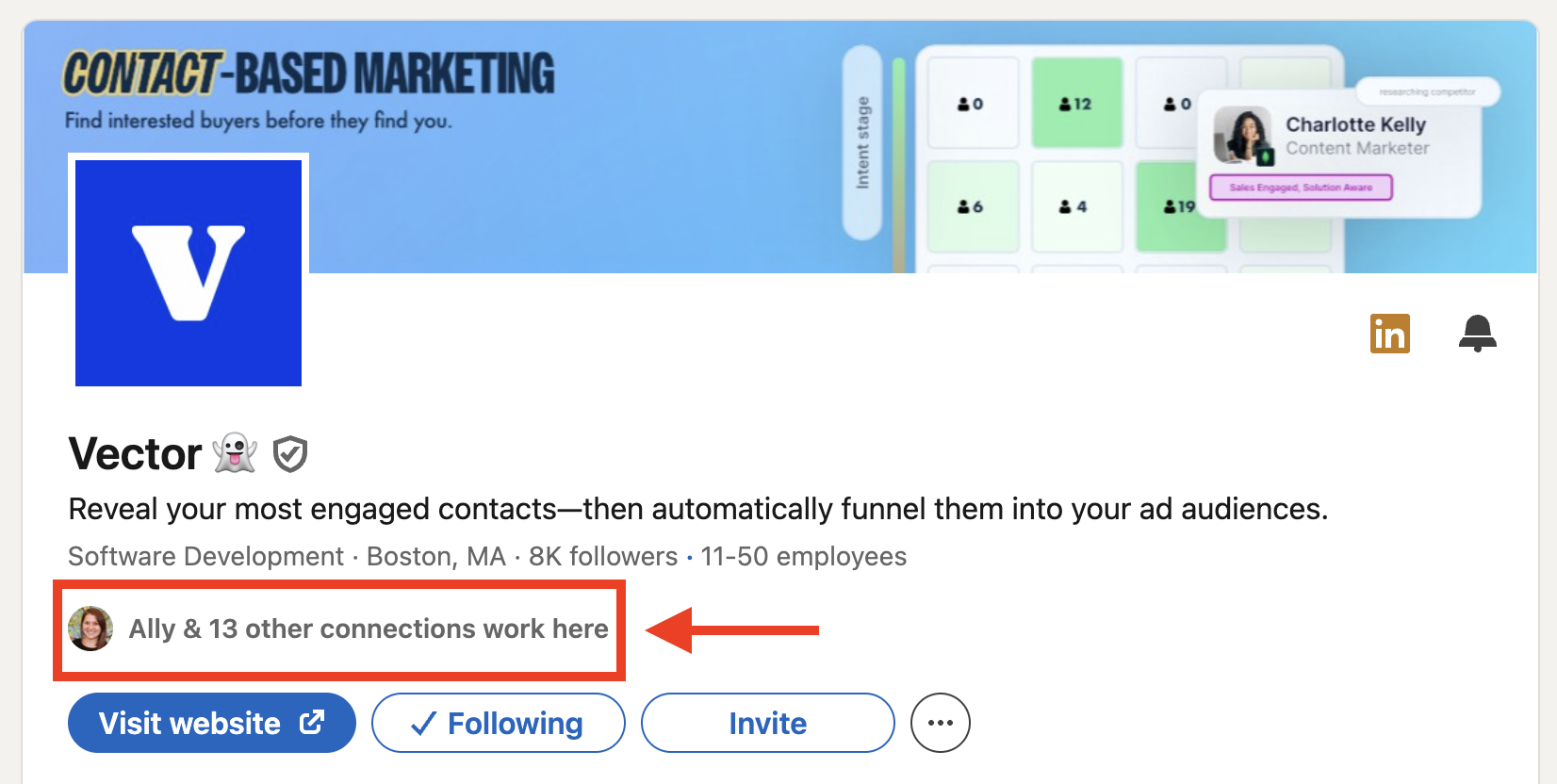
Now, this next part is important….do NOT cold message them, just asking for a referral. And certainly don’t demand a referral. I’d be upfront that you are looking for a referral, but start your message with a check in “How are you doing? It’s been a while!” etc. A little social nicety goes a long way.
If you’re targeting a large company, try to find someone within at least the department — IME, most companies don’t really take inter-department references very seriously, especially if you aren’t highly recommended personally by the employee. You want someone as close to the hiring manager as possible. This is not a “spray and pray” strategy, you very much want to be as warm, appreciative, and approachable as possible with these messages.
When headcount is tight, most hiring managers are pretty risk-averse. They look for personal references or recommendations over recruiter-sourced candidates. Look towards people you know or have worked with (and who will speak highly of you) for references to get ahead in the candidate line and to have a real shot at the role.
What About When Things Go Wrong?
If you get rejected for a role, try your best to not take it personally. My brother had some great advice for me back in the day: interviewing for jobs is like dating, you never know why you truly were accepted or rejected. You could assume that you bombed the interview, but it could be as simple as wearing a color shirt that the hiring manager hates…especially in a competitive market. The key is to ask for feedback and keep trying!
If you notice a pattern of rejections across the board, do ask for feedback and look for any patterns. While you can’t control the outcome or knowing precisely what it will take to get picked for a role, you can improve your chances by addressing any obvious issues like coming across as low energy, too junior for a role, not enough experience in a specific area, etc.
A common issue my mentees bring to me is being seen as not ready or too junior for a management or executive role. While you can’t have total control over this (most orgs prefer someone who has previously been a manager or executive, and I don’t want to discount how difficult it can be to convince them otherwise), you can ask for feedback and notice the pattern. If you get this feedback, reflect closely on the questions they asked and how you answered: the most common pitfall I see MOPs folks fall into is being too technical in responses, instead of more strategic or bigger-picture.
If someone asks you how you improved marketing and you answer “I migrated us from Marketo to HubSpot” that comes across as too tactical…no one outside of MOPs really cares. They’re looking for something more like “I migrated us from Marketo to HubSpot, which saved the business $100k per year — we then reallocated those savings to campaigns, which helped us achieve 2x pipeline compared to the previous year.” Always tie MOPs-specific terms (like Marketo, MAP, CRM, etc) to a marketing strategy number, like pipeline, revenue, ARR, etc. This will help you avoid the trap of being seen as too tactical or too siloed within MOPs.
Here are some examples to help:
Tactical Term / Phrase (Avoid) | Strategic Term / Phrase (Use Instead) |
“I migrated us from Marketo to HubSpot.” | “I migrated us from Marketo to HubSpot, which reduced costs by $100K that we reallocated into demand campaigns, helping us double pipeline year-over-year.” |
“I built reports in Salesforce/HubSpot.” | “I developed a reporting framework that gave executives visibility into marketing ROI, enabling data-driven budget reallocations that increased ROI by 30%.” |
“I cleaned our database.” | “I implemented a data governance program that improved email deliverability and increased campaign conversion rates by 15%.” |
“I set up lead scoring.” | “I introduced a lead scoring model that aligned sales and marketing, improving MQL-to-SQL conversion by 25%.” |
“I managed our MAP (Marketing Automation Platform).” | “I optimized our marketing automation to support ABM and lifecycle programs, accelerating expansion revenue by 20%.” |
“I ran email campaigns.” | “I scaled lifecycle nurture programs that reduced churn by 10% and increased product adoption in our Growth tier.” |
“I set up integrations between systems.” | “I designed an integrated tech stack that enabled full-funnel attribution, proving $5M in influenced pipeline.” |
“I created dashboards.” | “I delivered executive dashboards that allowed the CMO to cut underperforming spend and reinvest in channels that delivered 3x pipeline.” |
“I worked with sales on processes.” | “I partnered with sales leadership to align SLAs, which cut lead response time in half and improved close rates.” |
“I automated manual tasks.” | “I automated processes that freed up 200+ hours/quarter, allowing the team to focus on revenue-driving activities.” |
And here’s a table of more strategic terms you need to know and try to use:
Term to Use | Definition |
Pipeline | The total value of qualified opportunities in the sales process, often used as a measure of marketing and sales effectiveness. |
Revenue | Money generated from customers; the ultimate measure of business impact tied directly to marketing and sales activities. |
ARR (Annual Recurring Revenue) | Predictable, recurring subscription revenue normalized over a one-year period, key for SaaS business growth. |
NRR (Net Revenue Retention) | Revenue retained from existing customers after upgrades, downgrades, and churn — shows long-term customer health. |
Attribution | The practice of determining which marketing and sales activities contributed to pipeline or revenue. |
Alignment | Cross-functional coordination between marketing, sales, and customer success to achieve shared revenue goals. |
Efficiency | Achieving greater output (pipeline, revenue) with fewer resources, often through automation or process optimization. |
Conversion | The process of moving prospects through funnel stages (MQL → SQL → Opportunity → Closed Won), directly tied to pipeline velocity. |
Cost Savings | Reduction of expenses through tool consolidation, automation, or process improvements, freeing budget for growth initiatives. |
What About Projects or Assignments?
I personally refuse to do assignments…controversial, I know. It might make sense some day, if I’m interviewing for a VP+ role and do not know the hiring manager well…but in the meantime, I see projects as too risky to be worth it. Why?
- Some orgs abuse this practice by making 5+ people do projects, as an early stage of the interview process…this is a waste of your time. Projects should be used to help make a final decision between two very strong candidates, not as a basic filter because companies don’t know how to interview effectively.
- Some orgs will use projects to get free labor or intel, and then hire someone more junior to implement.
- Some orgs have no idea what they’re looking for, and a project is their way of “flailing”…so you could do the project, only to find that they’ve “done some reflecting and realized they need an XYZ expert instead.” Waste of time again.
However, I know that some orgs require projects, SO here is my practical advise if you find it worthwhile to do a project:
- Ask the recruiter or hiring manager if you are one of 2-3 candidates left — and if it’s the last step. If there are 4+ candidates and 2+ more steps left, RUN. Or, at least ask if you could push the project to a later stage.
- Make sure you’ve discussed compensation prior to doing this project. You don’t want to spend hours on a project, only to discover that they’re $50k below your desired salary.
- Ask them when they’re looking to make this role by. If you get any sense of uncertainty or shiftiness, I would hesitate. The answer you’re looking for here is something like “We have 2 super strong candidates left, you and one other candidate — we are looking to review these projects and pick a candidate by end of next week.” ←- This indicates they are serious.
If you’re interviewing with more than one company, let’s say company A and company B: if company A makes you an offer, while company B is asking for a project, let company B know that you have an offer in hand.
This can help push things forward with company B — if they are leaning towards giving you an offer, they’ll likely forget the project and make the offer to you instead of potentially losing you. If they insist upon their project, even if they might lose you as a candidate, that probably indicates that they are leaning towards another candidate.
YMMV here, I’m sure I’m going to hear from some hiring manager who says they must follow a process no matter what, etc. 😅🤣
Want to Practice or Share?
If you're prepping for a Marketing Ops interview — or recently hired someone in MOPs — reply or message me on the newsletter email. I’m collecting real stories to share in a future piece.
Related Guides
🤖 The 2025 Guide to AI in Marketing Operations
A 2025 guide to AI in Marketing Operations, focused on practical processes you can implement, govern, and improve across your GTM stack.
🪢 The Pre-Wire -- Stakeholder Map + 1:1 Script
Good work rarely wins approval on its own; the people who get a yes line up support before the call is made. This guide hands you a stakeholder map and a pre-wire script to count the votes -- and win them -- before you walk into the meeting.

The Marketing Operations Strategist Newsletter
Join 3,500+ operations professionals. Get actionable MOPs tips every month.