Resource
🪢 The Pre-Wire -- Stakeholder Map + 1:1 Script
6/25/2026
In Congress, they call it whipping the vote — it’s when you convince people to vote a certain way BEFORE scheduling the actual vote.
Similarly in the corporate world, decisions get ratified in the meeting room, but are usually made much earlier. To get ahead of this, it helps to map out who really decides, then pre-sell the call one conversation at a time. Walk in with the vote already counted. This is the mastering of “influencing without authority.”
And before you write this off as “management stuff” — if you ever need approval for a project, a tool, or anything else, you need to build this influence muscle. So don’t dismiss the importance of this, for all ops peeps!
1. Stakeholder Map
Tag each person by power/role, not title. While not everyone fits neatly into a box, you can usually categorize people as a Decider, Shaper, Blocker, or Spectator.
A few quick role definitions:
- Decider — the single person whose yes is the one that makes this happen. They hold the authority (and usually the budget). Most decisions have exactly one.
- Shaper — can't make the final call, but the Decider borrows their read. When the Decider hesitates, this is who they ask.
- Blocker — can't greenlight it, but can kill it. Think legal, security, finance, or a territorial peer. Their power is the veto, so you defuse the objection in private before it goes public.
- Spectator — no real say in the outcome, but wants to be kept in the loop so nothing blindsides them. Leave them out and they can turn into a Blocker out of spite 😅 A two-line heads-up usually does it.
Stakeholder | Role | Their currency (wants / fears) | Stance | Likely objection | Pre-wire move (goal of the 1:1) | Status |
Priya (VP Marketing) | Decider | Pipeline coverage for the half; looking good to the CRO | Lean for | "Can we afford the lift right now?" | Show the 2-week build plan + who owns it, get a verbal yes. | Done |
Marco (Sales Dir.) | Shaper | Rep productivity; hates anything that slows reps down | Neutral | "This adds steps for my team" | Walk him through the rep view (confirm zero added clicks!) | Scheduled |
Dana (RevOps Lead) | Blocker | Data integrity; got burned by a messy rollout last year | Lean against | "The data model isn't ready" | Pre-share the QA plan. Ask her to co-own the checks. | Not started |
Sam (Finance) | Spectator | Wants no budget surprises | Unknown | "Was this in the plan?" | 2-line heads-up email so he's not surprised in the room. | Not started |
ㅤ | ㅤ | ㅤ | ㅤ | ㅤ | ㅤ | ㅤ |
ㅤ | ㅤ | ㅤ | ㅤ | ㅤ | ㅤ | ㅤ |
ㅤ | ㅤ | ㅤ | ㅤ | ㅤ | ㅤ | ㅤ |
ㅤ | ㅤ | ㅤ | ㅤ | ㅤ | ㅤ | ㅤ |
ㅤ | ㅤ | ㅤ | ㅤ | ㅤ | ㅤ | ㅤ |
ㅤ | ㅤ | ㅤ | ㅤ | ㅤ | ㅤ | ㅤ |
Dropdown values (set these as a Select property in Notion if you turn the table into a database):
- Role: Decider · Shaper · Blocker · Spectator
- Stance: For · Lean for · Neutral · Lean against · Against · Unknown
- Status: Not started · Scheduled · Done
2. Relationship chart
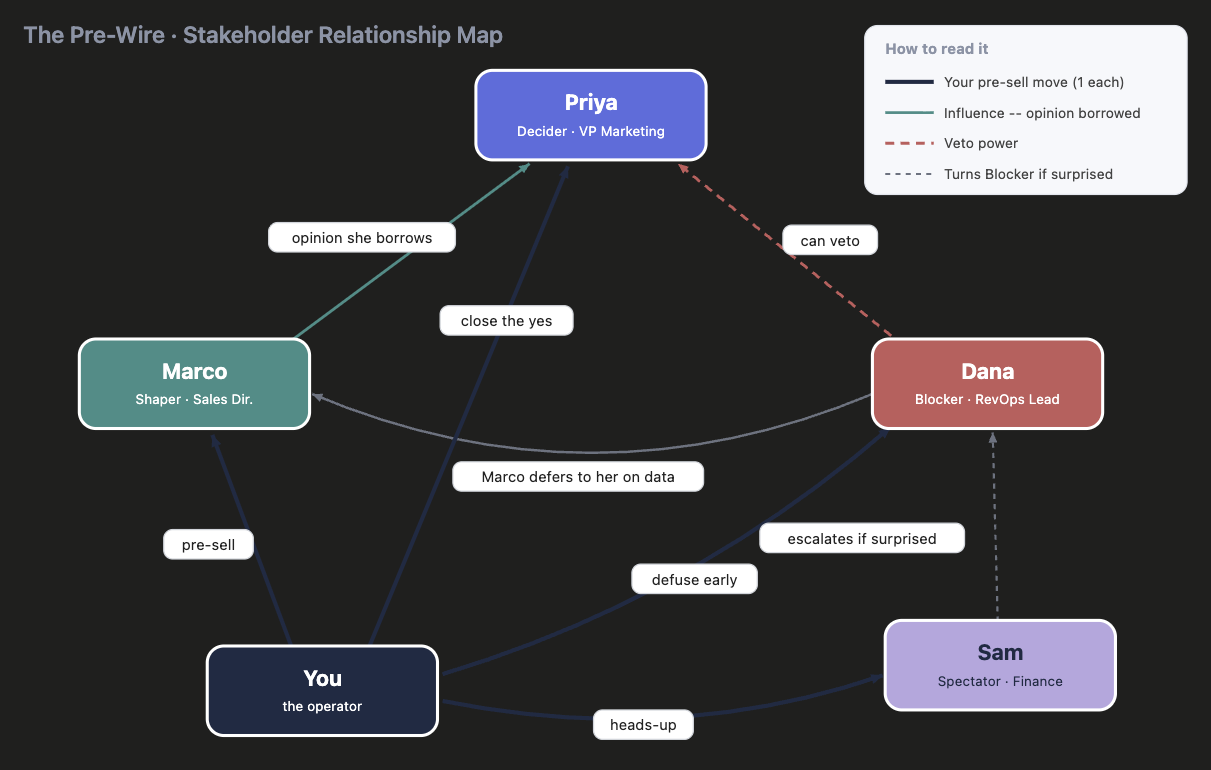
If this is a really critical decision and you’re trying to make sure it’s a slam dunk, it could be worth using a tool like Miro or Canva to diagram out the stakeholders and their relationships — especially if some leaders defer to others, some are BFFS, etc. Just be careful to not keep this on your work computer if it’s sensitive at all. 😅
3. Vote Count
Tally before you book the room:
For (incl. lean for): ____
Against (incl. lean against): ____
Neutral / Unknown: ____
Pre-wires still to do: ____
Rule of thumb: If you can't see a majority of Deciders + Shapers at "For" before the meeting, you aren’t ready yet.
4. The 1:1 Script
You should aim for one private conversation per person. The goal is to surface the real objection while you can still fix it, and get a soft yes before the call.
Before the call
Re-read this person's row. What's their “currency”? What objection are you betting they'll raise? Decide the one outcome you want from these five minutes.
🎤 Open (lower the stakes)
"Quick one before Thursday -- I'm bringing the [proposal] to the group and I'd rather get your read now so I can take in any initial feedback. Got two minutes?"
🖼️ Frame on their currency
Pitch the version that moves their metric, not yours.
"The reason I think this matters for [their goal] is ___."
🎣 Fish for the real objection
"What would make you hesitate to back this?"or: "If you were going to poke a hole in it, where would you poke?"
🚗 Handle it (or park it honestly)
If you can solve it live, go ahead and solve it. If you can't, name it and own the follow-up:
"Fair. Let me come back to you with the QA plan before Thursday."
👛 Soft close (bank the yes)
"If I get you that, are you on board?"
A soft yes in private is the vote you're counting.
⚠️ After
Update their row with their new stance, and mark the status Done. If they moved to Against -- well, at least it’s better to know now instead of discovering it live.
Reminder: These 1:1s are useful for every Decider and Shaper, plus any Blocker who could potentially sink you. Spectators usually just need a heads-up email, not a meeting.
5. If the votes aren't there yet
A short count before the meeting is a gift -- you found out while you can still fix it. Four moves:
Shrink the ask — when you can’t quite drive consensus but nobody objects to one part of it, carve out the uncontested piece and ship that first. A pilot is easier to approve than a program.
Delay the meeting — when you can't get a majority and the date is close, push it a week and pre-wire again. Nobody remembers a meeting that moved; everybody remembers the one you lost, and it’s harder to recover from there (this is assuming the decision is not time-sensitive!).
Recruit a second Shaper — when the Decider is on the fence, win over the person that they trust, then let that person support your argument in the larger room.
Give a Blocker a win — when the Blocker is protecting something, not hating the idea itself, hand them a version that protects what they’re concerned about, like having control: co-ownership of the QA plan or a phased rollout. A Blocker with a stake sometime easily becomes a Shaper.
Remember: A "no" right now is information, not a verdict -- use it to fix the plan before it goes public.
The one thing to remember
In ops, it’s so easy to get stuck in the shadows. We’re usually technical and enjoy the weeds of things, fixing things…not the flashiest, most attention-seeking work. BUT if we don’t learn how to internally market ourselves and our work (and influence others), we will also be in the shadows on budget, headcount, and other resourcing.
SO, even if you are an IC — you’ll likely run into scenarios where you need to influence and win consensus or approval on new initiatives, projects, and more…so this is relevant to you, too! Use it, make it your own. 👍
Related Guides
🕵️♂️ Intent Data Use Case Template
An intent data use case template for GTM teams with structured examples to plan prioritization, segmentation, campaigns, and sales enablement.
🎸 Pro Tips from 10+ Years: How to Run Campaign Ops Like a Rockstar
Campaign ops lessons from 10+ years in the field, with practical tactics to run launches smoothly, reduce rework, and improve cross-team execution.

The Marketing Operations Strategist Newsletter
Join 3,500+ operations professionals. Get actionable MOPs tips every month.